





Most of us choose a bag for how much it holds and how it looks. Your body only cares about one thing: how the weight is carried.
Ask most people what they want in a backpack and they'll tell you about litres, pockets and colour. Ask them about the straps and you get a blank look. Yet the straps, and the way the weight sits on your back, are the part your body actually registers at the end of a long day. A bag can tick every other box and still quietly work against you.
It's the part we pay the most attention to when we decide which bags earn a place in the emmèton range. Security and good looks matter, but a bag you carry every day has to carry well first, or it doesn't make the cut. So we spend our time on the unglamorous details: the straps, the back panel, and the way a full load actually sits on your back.
There's a number, and most of us are over it
Physiotherapists tend to agree on a rough ceiling: a loaded backpack should sit under about 15% of your body weight. For someone around 70 kilograms (about 154 lb), that's a little over 10 kilograms (around 22 lb), bag included. It sounds generous until you weigh what you actually carry. A laptop, a charger and its cable, a water bottle, a book, a spare layer, the gym gear you meant to take out. It adds up faster than you'd think, and a lot of us are over the line, on straps that were never built to hold it well.
The consequences aren't dramatic, which is part of the problem. They arrive slowly. In one widely-cited survey, most people said their bag was too heavy, around two thirds reported fatigue, and close to half reported back pain from carrying it. Sore shoulders, a stiff neck, the small habit of leaning forward to counter the load. None of it announces itself. You just start filing it under normal.
It isn't only the weight. It's how it's carried
Here's what the litres-and-looks conversation misses. Two bags of exactly the same weight can feel completely different, because a good carry system moves the load off the places that hurt.
Shoulder straps do less than people assume. Their real job is to position and steady the bag, not to bear all of it. Thin and unpadded, they turn a manageable load into two pressure points that dig in within a block. Wide, padded straps spread that same weight across more of your shoulder, so nothing concentrates in one spot.
A sternum strap, the small clip across your chest, carries no weight at all. What it does is stop the shoulder straps sliding outward and keep the bag from swaying as you move, which matters more than it sounds on a set of stairs or a moving train. Done up lightly, not cinched tight, it holds everything quietly in place.
Big hiking packs add a third piece, a hip belt, which does the real work by transferring most of the load onto your hips, where your skeleton is built to carry it. A daily commuter bag doesn't need one. What it needs is the first two done well, plus a structured back panel that holds the weight high and close to your spine rather than letting it sag away from you.
A bag that keeps the load tight to your back is a bag your body barely notices.
The fix is mostly free
Most of this costs nothing. Pack to the weight on purpose and take out what you haven't touched in a week. Wear both straps, always, never one, so the load stays even. Do up the sternum strap. Tighten the shoulder straps until the bag sits high on your back rather than slumping toward your hips. Keep the heaviest things closest to your spine. Do those five things and a bag you already own will treat you better tomorrow.
The one thing technique can't fix is the bag itself. Thin webbing straps and a flat, unstructured back will fight you no matter how carefully you pack.
What a bag built for the load looks like
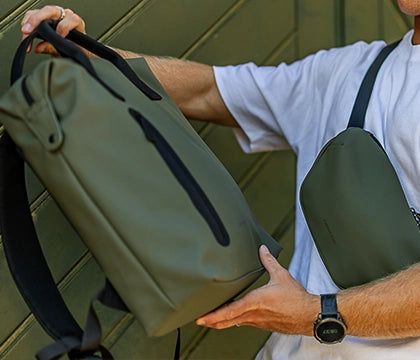
This is where the choice earns its place. The Commuter 20L is one we brought into the range for exactly this, and it has the parts that matter: padded shoulder straps that spread the load, a sternum strap to stop it swaying on a packed train, and a structured, padded back panel that holds the weight close and keeps the 20 litres from bulging away from you. It isn't a spec list for its own sake. It's the difference between a bag you feel all day and one you forget you're wearing.
And if you want the easiest possible starting point, start light. The Urban 17.5L is our slimmest laptop backpack at around 0.7 kilograms empty, so you're carrying less before you've packed a single thing. The lightest load is the one you never added.


Left: the Commuter 20L, with padded shoulder straps, a sternum strap and a structured, padded back panel. Right: the Urban 17.5L, the same padded straps and sternum clip in a slimmer, lighter build at 0.7kg.
None of this is medical advice, and if you already have back or shoulder pain it's worth seeing a professional rather than reading a journal. But for the ordinary ache most of us have quietly filed under normal, the cause is often the most overlooked thing we own. Not the litres. Not the look. The straps, and the way they carry the weight you forgot you were holding.
Sources: general backpack ergonomics guidance, North Lake Physical Therapy; carry-system mechanics, Eiken materials guide; and Ismail et al., "Impact of Backpacks on Ergonomics: Biomechanical and Physiological Effects, A Narrative Review," International Journal of Environmental Research and Public Health, 2022. General guidance only, not medical advice.


